Sustainability in Indian Distilling: From Afterthought to Imperative
A decade ago, sustainability was largely peripheral to how Indian distilleries talked about themselves. Compliance with environmental clearances was the bar, and few facilities went beyond it.
The landscape has shifted. ESG requirements from institutional investors, procurement standards from international brand partners, tighter water and effluent regulations from state pollution boards, and genuine cost pressures from energy and waste disposal have collectively moved sustainability from a compliance checkbox to a strategic priority.
Associated Alcohols & Breweries Limited’s approach at their Barwaha, Madhya Pradesh facility reflects this shift. The company has made material capital investments, including a ₹150 crore grain-based ethanol plant, that simultaneously serve commercial and environmental objectives. This commitment is also reflected across AABL’s broader Green Us initiatives, which document how environmental responsibility is embedded into the company’s operations at every level.
Understanding how AABL operationalises sustainability across its production chain offers a useful framework for what responsible large-scale distilling looks like in India today.
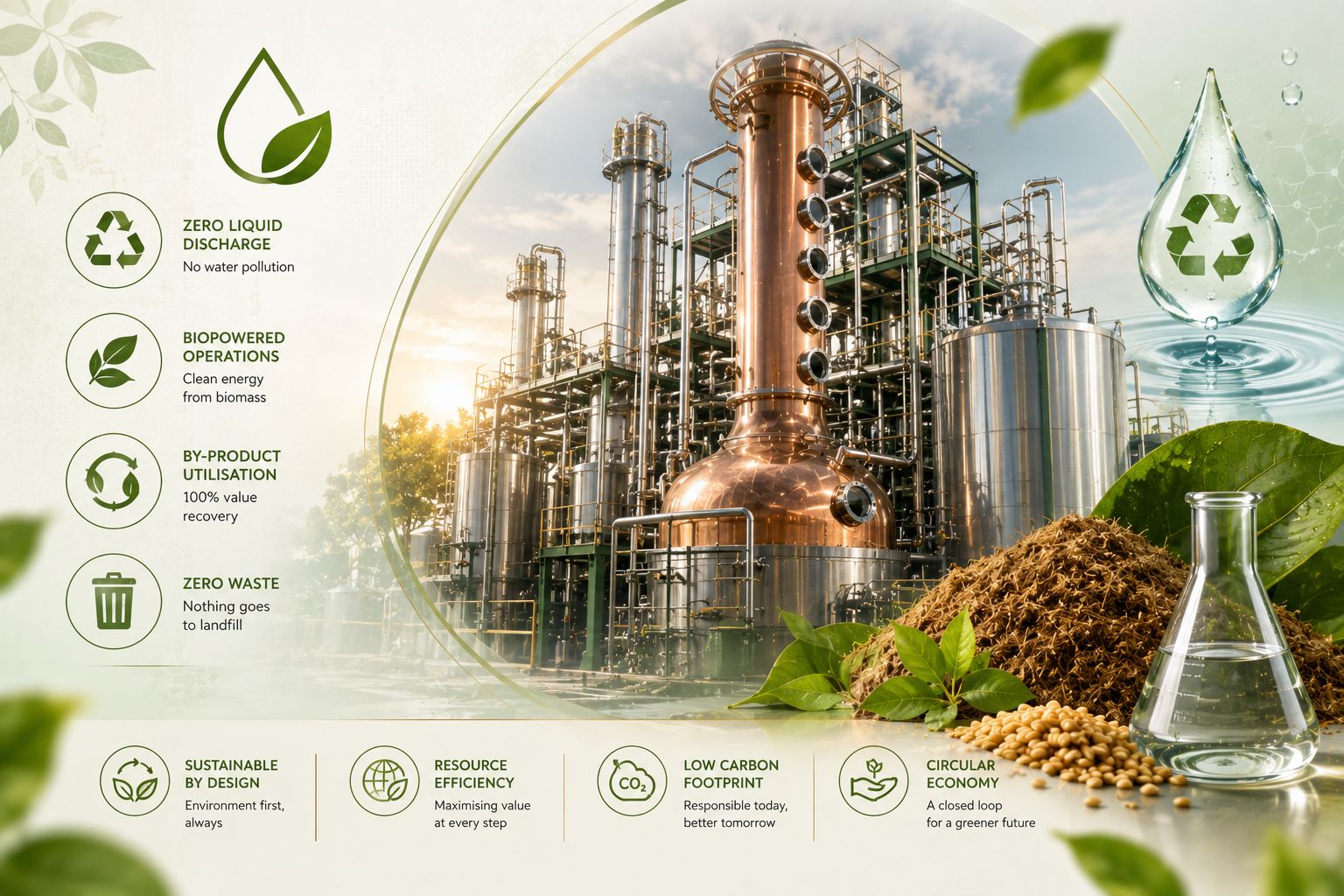
Zero Liquid Discharge: The Foundation
The most significant environmental challenge for any grain-based distillery is effluent management. Distillation generates large volumes of spent wash—a high-BOD (Biological Oxygen Demand) liquid that, if improperly handled, can cause serious water contamination.
India’s environmental regulations require modern distilleries to achieve Zero Liquid Discharge (ZLD), meaning no process effluent is released into natural water bodies.
ZLD is not a passive outcome. It requires substantial investment in effluent treatment infrastructure. Modern systems typically include multi-effect evaporators that concentrate spent wash, followed by incineration in specialised boilers or further processing into biogas.
The resulting concentrated solids can then be utilised as cattle feed ingredients or agricultural fertilisers, turning a waste challenge into a usable by-product stream.
AABL’s grain-based ethanol plant at Barwaha was designed with ZLD capability from commissioning. The facility processes grain feedstocks such as maize, broken rice, and sorghum while managing the entire liquid waste stream within the plant boundary.
This is not simply a sustainability commitment; it is an operational requirement built directly into the facility’s engineering design.
Grain-Based Ethanol: Circular Production Logic
The 130 KLPD ethanol plant at Barwaha represents a strong example of circular production thinking.
Rather than treating ethanol as a standalone industrial activity, AABL integrates ethanol production with its IMFL manufacturing operations at the same site. Grain feedstocks used for Extra Neutral Alcohol (ENA) production can also be routed toward ethanol production depending on the requirements of the Government of India’s Ethanol Blended Petrol (EBP) programme.
The EBP programme aims to achieve 20% ethanol blending in petrol across India, supporting both energy security and emissions-reduction goals.
As a result, grain-based ethanol produced at facilities such as Barwaha contributes directly to reducing national dependence on fossil fuels.
Equally important, the distillers’ grains remaining after fermentation and distillation are not discarded. These protein-rich solids become valuable animal feed products, effectively closing the loop on grain utilisation and reducing waste.
Energy Efficiency and the Co-Generation Advantage
Distillation is an energy-intensive process. Fermentation control, distillation columns, packaging operations, and process heating all require substantial thermal and electrical energy inputs.
Facilities that rely exclusively on conventional grid power or coal-based energy systems often face higher environmental impacts and operating costs.
AABL’s Barwaha facility operates an additional boiler alongside the ethanol plant that can utilise multiple fuel sources, including coal, rice husk, and biomass briquettes.
The inclusion of agricultural residues such as rice husk and briquettes is particularly significant. These materials might otherwise be openly burned in agricultural fields or discarded as waste. Using them as boiler fuel converts an agricultural by-product into a productive energy source.
This approach supports a co-generation model where thermal energy used for process steam can also contribute to on-site electricity generation through turbine systems.
By reducing dependence on external power sources, co-generation improves both environmental performance and operational efficiency.
Water Management in a Water-Stressed Region
Madhya Pradesh’s Khargone district, like many regions of central India, experiences periodic water stress.
For a large-scale distillery, responsible water management is not merely an environmental consideration—it is critical to long-term operational viability.
Water stewardship in an integrated distillery extends beyond ZLD systems. It also includes recycling process water, implementing efficient cooling systems, monitoring groundwater extraction, and reducing overall water consumption wherever possible.
AABL’s location near Indore was selected partly because of its proximity to agricultural raw materials. However, sustainable water management remains essential for maintaining reliable production in a region where water resources cannot be considered unlimited.
The combination of ZLD infrastructure and process-water recycling enables high-volume grain-based production while minimising environmental impact.
Packaging and Material Efficiency
Sustainability extends beyond production processes and into packaging operations.
Glass remains the primary packaging material for premium spirits, but glass manufacturing carries significant energy and transportation costs. Optimising bottle weight, improving packaging efficiency, and maximising transport density all contribute to reducing the environmental footprint of finished products.
AABL’s bottling facilities handle a wide range of packaging formats across 32 bottling lines, including premium glass bottles as well as PET packaging for economy IMFL and IMIL segments.
Managing multiple packaging formats at scale requires careful planning to minimise production waste, material loss, and changeover inefficiencies.
The same operational discipline that supports quality control also contributes to improved material efficiency and reduced waste generation.
The ESG Case for Choosing a Responsible Distillery Partner
For brand owners, investors, and procurement managers, sustainability credentials are becoming an increasingly important component of supplier evaluation.
Many international beverage companies now require contract manufacturing partners to meet specific environmental, social, and governance (ESG) standards as part of their procurement processes.
A distillery that operates with Zero Liquid Discharge systems, integrated effluent treatment infrastructure, multi-feedstock flexibility, and documented environmental compliance presents a lower ESG risk profile for its partners.
This capability is emerging as a meaningful competitive advantage within India’s contract manufacturing sector, particularly as many smaller facilities continue to operate with older environmental management systems.
Conclusion
Sustainability in Indian distilling is no longer a peripheral consideration. It has become a central business requirement driven by regulation, investor expectations, customer demands, and operational economics.
Facilities that integrate responsible water management, circular production systems, energy efficiency, and waste reduction into their core operations are better positioned for long-term success.
AABL’s investments at Barwaha illustrate how environmental responsibility and commercial performance can align when sustainability is treated as a strategic priority rather than a compliance obligation.
As India’s distilling industry continues to evolve, the organisations that embed sustainability into every stage of production are likely to define the next generation of responsible manufacturing.