India’s Premium Whisky Moment
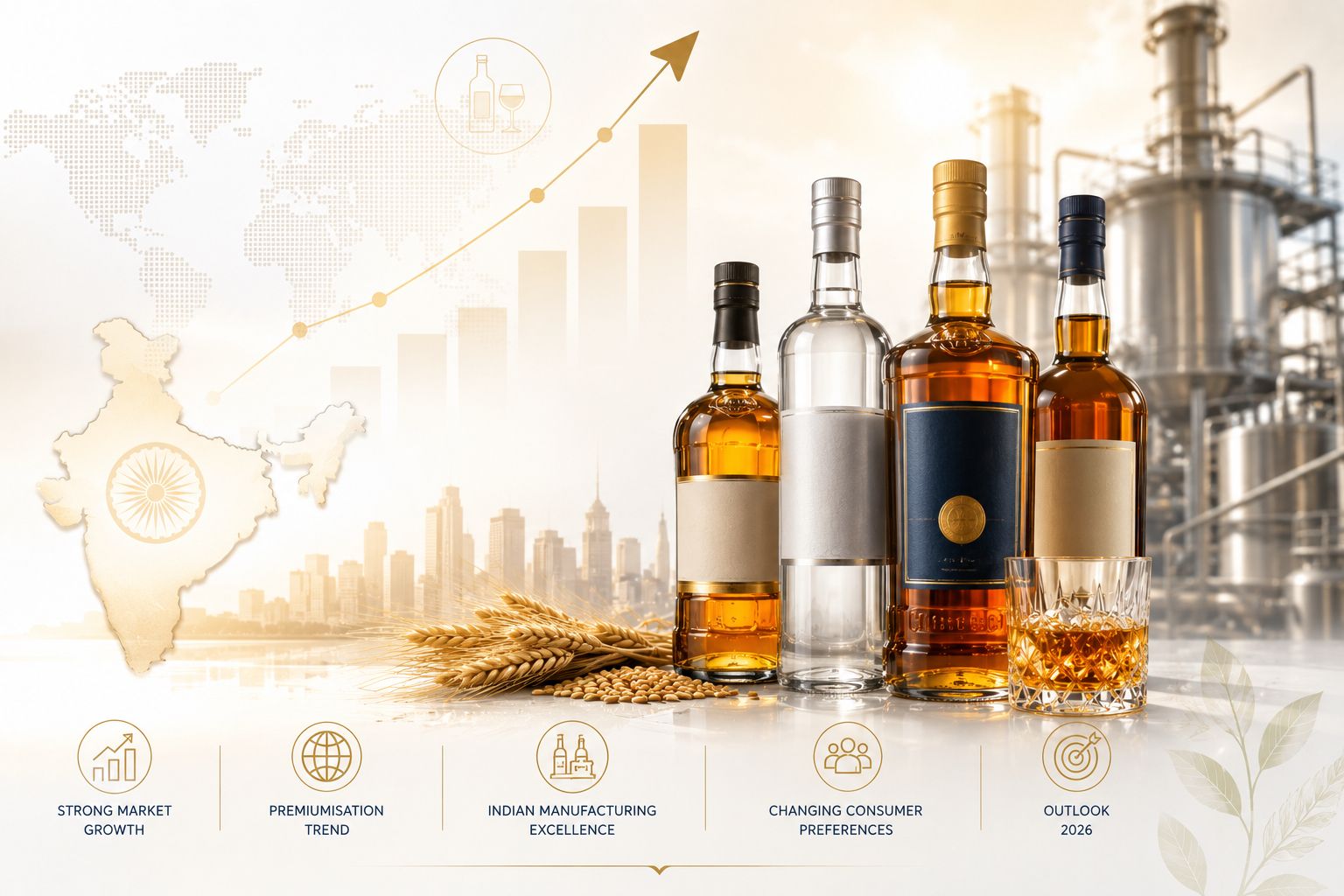
India drinks more whisky than any other country on earth. The sheer scale of the market has long been understood. What is changing in 2026 is what Indian consumers are drinking and what they expect from the category.
The entry-level IMFL whisky that dominated the market through the 2000s is being steadily complemented in urban markets, partly displaced by premium and super-premium expressions that compete on quality rather than just price and distribution. Indian single malts are winning international awards. Global distilleries are investing in Indian production and distribution. And a generation of consumers who grew up with craft cocktails and premium spirits now brings genuine curiosity to the whisky category.
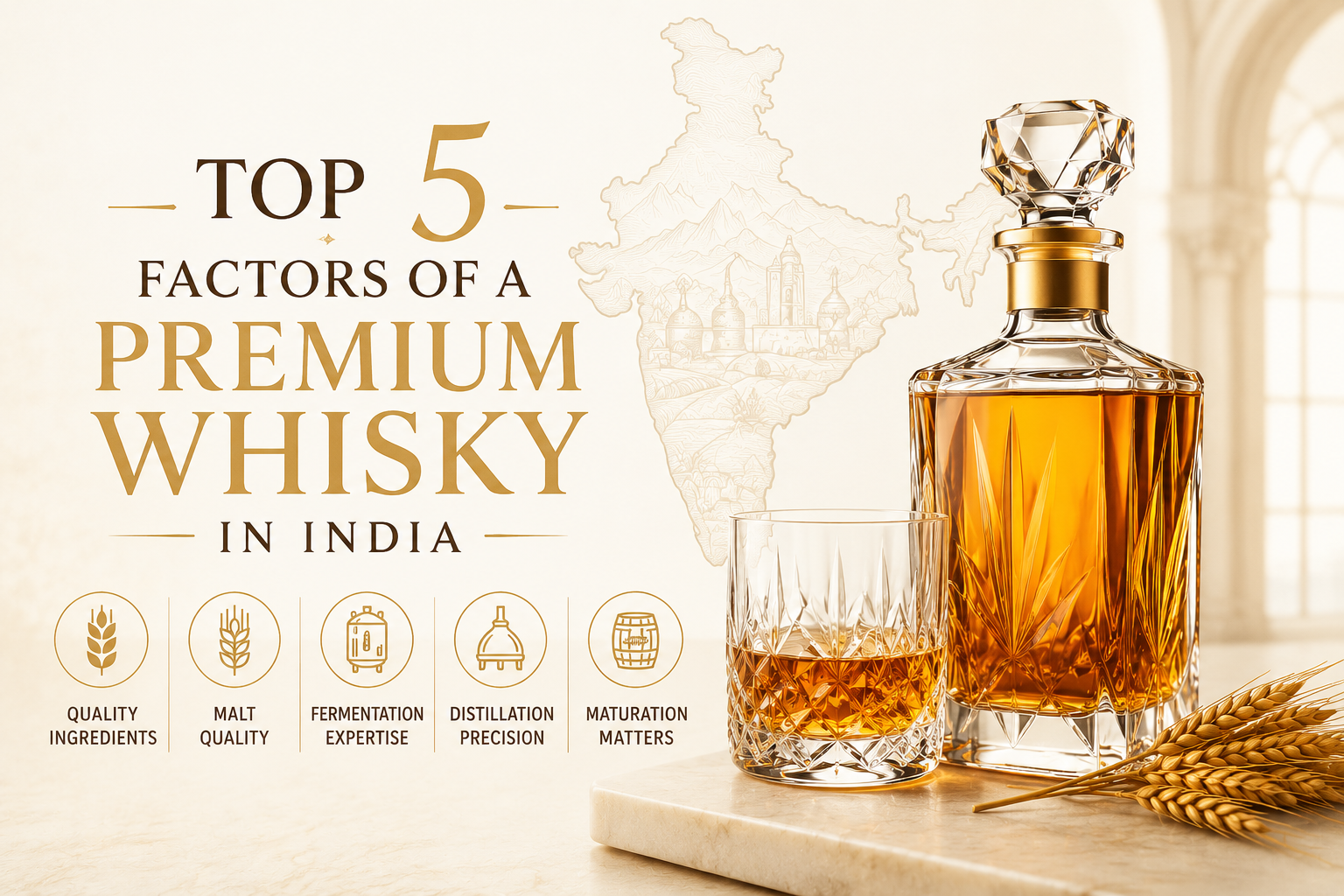
What actually separates a premium Indian whisky from a standard one? The answer is not marketing language or packaging. It comes down to five production and maturation factors that consistently determine where a whisky sits on the quality spectrum.
Factor 1: The Quality of the Base Spirit (ENA)
Most IMFL whiskies are built on Extra Neutral Alcohol. ENA is a high-purity grain spirit produced through multi-column distillation, and it forms the bulk of the final blend in most Indian whisky expressions. This is structurally different from Scotch or bourbon, where the entire spirit is produced from malted barley or grain in pot and column stills.
In the Indian context, this makes the purity and consistency of ENA the single most important quality variable. ENA produced with poor fermentation hygiene, inadequate distillation cuts, or from low-grade grain carries off-flavours that no amount of blending or maturation can fully correct.
Premium Indian whiskies are built on ENA produced at verified purity levels, from consistent grain sources, by distilleries with controlled fermentation and precise column distillation. AABL, for example, produces ENA at 45 MLPA capacity for its own AABL brands and supplies it to major international brand partners who maintain stringent quality specifications and practical validation of the quality standard their ENA achieves.
Factor 2: Malt Content and Blending
The character and complexity of a premium Indian whisky depends significantly on its malt component. Indian regulations allow whiskies to be labelled as ‘whisky’ with a relatively low malt content, which has historically meant that economy-tier IMFL contained minimal malt. Premium expressions differentiate themselves by incorporating higher proportions of aged malt whether Indian malt, or imported Scotch malt concentrate.
The India-UK FTA, expected to increase bulk Scotch availability and competitiveness in India, is likely to make higher-malt-content premium Indian whiskies more commercially viable. Distilleries that can handle complex blending combining house ENA with multiple malt stocks and ageing them together before final blending have a distinct quality advantage. This is also why partnerships through license brands play an important role: they bring international blending knowledge and malt specifications into the same production environment.
Blending is an art that compounds on itself. A skilled master blender who knows the flavour profiles of each component stock, understands how they evolve in cask over time, and can construct a consistent final expression is a scarce resource. This is why the most respected distilleries in Indian whisky maintain dedicated blending teams with years of institutional knowledge.
Factor 3: Maturation and Cask Management
Whisky gets its colour and the majority of its flavour from wood. Up to 70% of the final flavour profile in a matured whisky is attributed to cask interaction. In India, the maturation environment is strikingly different from Scotland: temperatures regularly exceed 35°C in central India, humidity varies dramatically by season, and the ‘angel’s share’ (evaporation loss) runs significantly higher than in cooler climates.
This is a double-edged factor for Indian whisky. Higher temperatures accelerate the extraction of wood compounds, meaning Indian whiskies can develop cask-derived flavours quickly. But without careful management, over-extraction and excessive tannin pickup can result in harsh, unbalanced expressions.
Premium Indian distilleries manage this through careful cask selection (first-fill and refill ex-bourbon and ex-sherry casks are common), warehouse design that moderates temperature variation, and regular sensory assessment of cask samples to catch the optimal maturation point before withdrawal.
AABL’s commissioning of a dedicated single malt facility in 2025 reflects the growing sophistication of cask management in Indian distilling. Producing an aged single malt requires warehouse infrastructure, cask procurement, and a multi-year maturation programme investments that separate serious long-term players from those seeking short-term volume.
Factor 4: Water Quality
Water makes up the largest volumetric component of a bottled whisky after spirit and cask dilution. Its mineral profile directly affects mouthfeel, finish length, and how flavour compounds are perceived on the palate.
Distilleries in Scotland historically positioned themselves around specific water sources, soft Highland water versus harder lowland sources as a key quality differentiator. Indian distilleries have been slower to foreground water, but the most technically rigorous facilities treat water quality as seriously as any other input.
Consistent hardness, low chlorine, and the absence of contaminating minerals are minimum requirements. Facilities that process and treat their water to precise specifications before use in production rather than relying on variable local supply produce more consistent products. This matters especially in central India, where groundwater mineral profiles can vary significantly by season.
Factor 5: Production Consistency and Quality Systems
A whisky can be exceptional once. Making it exceptional batch after batch, year after year, requires systems not just talent.
Premium whiskies are defined partly by their consistency. When a consumer buys a bottle expecting a specific flavour profile, the expectation is that the whisky delivers it. Meeting this standard at scale requires:
- Documented batch records that create a data trail from grain to bottle.
- A functioning sensory panel that evaluates every batch against a reference standard.
- Laboratory testing for ABV, congener levels, and purity.
- Defined blending protocols that can be replicated across different production runs.
- Robust packaging quality control across bottling facilities to prevent defects that damage shelf appearance and consumer trust.
Facilities that operate contract manufacturing for major international brands as AABL does for Diageo have to meet quality system standards that exceed typical domestic requirements. The rigour developed for international brand production carries over into the quality of in-house premium products.
The Emerging Indian Single Malt Category
India’s single malt segment warrants separate attention. Unlike standard IMFL whisky, single malt production requires 100% malted barley, pot still distillation, and cask maturation the same fundamental process as Scotch single malt, but in a dramatically different climate.
The accelerated maturation that India’s heat provides means that Indian single malts can develop complex, characterful profiles in fewer years than their Scottish counterparts. Some Indian expressions have demonstrated that three to five years of maturation in carefully selected casks can yield whisky that competes with eight to ten-year Scotch in flavour complexity.
AABL’s single malt investment positions the company at the intersection of this trend. The first expressions from their dedicated unit are expected by FY27, by which time the Indian single malt consumer base will be materially larger than it is today.