
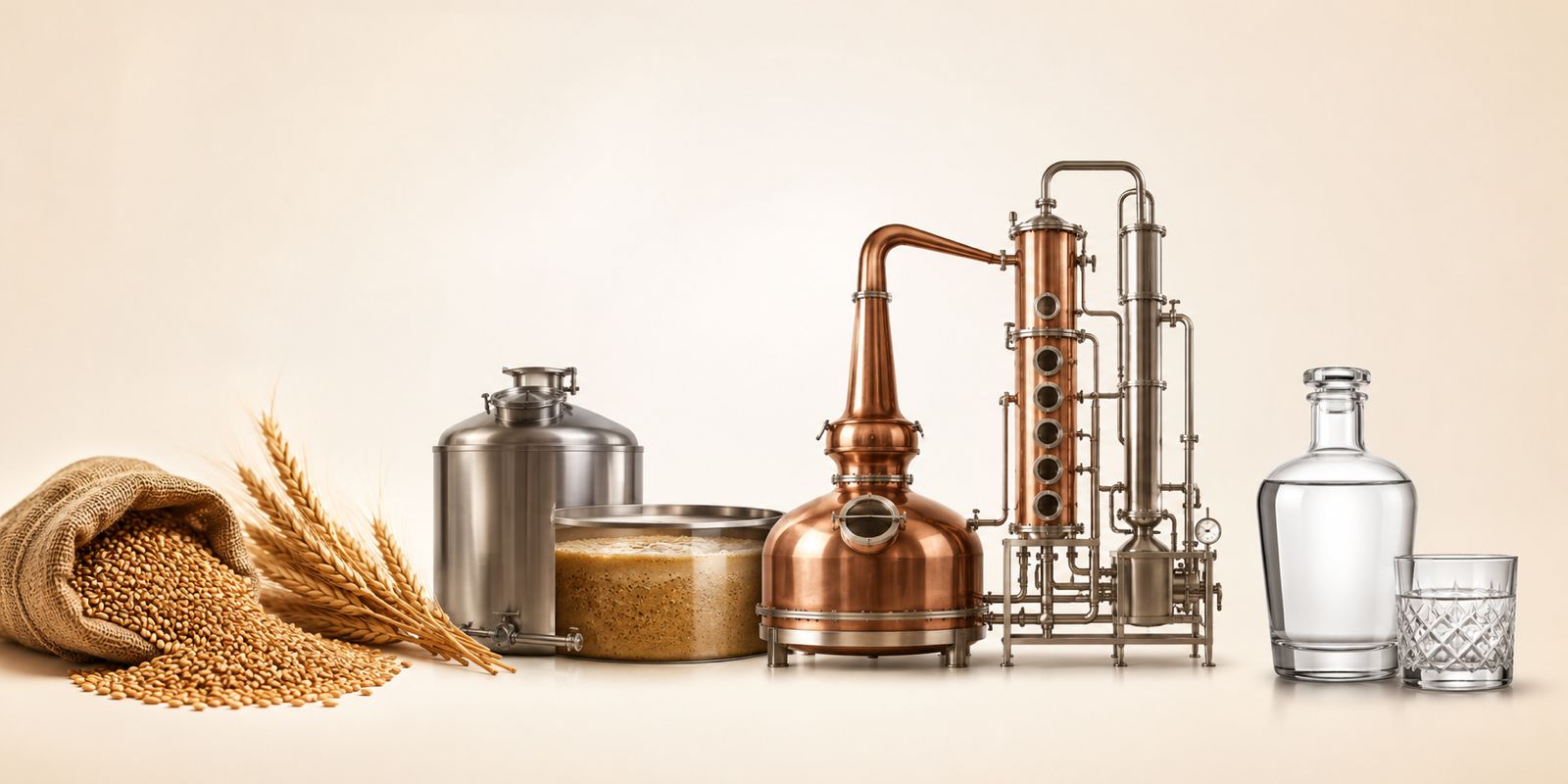
What Does ‘Grain to Glass’ Really Mean?
The phrase ‘grain to glass’ gets thrown around frequently in spirits marketing, but few distilleries in India apply it with the rigour it demands. At its core, the concept means complete ownership and control across the full production chain from the selection of raw grain through fermentation, distillation, maturation, blending, and final bottling with no step handed off to a third party.
For Associated Alcohols & Breweries Limited (AABL), this is not a branding exercise. It describes their operating reality at their integrated manufacturing facility in Barwaha, Khargone district, Madhya Pradesh, one of the most comprehensively equipped distillery complexes in India.
Why Location and Raw Material Sourcing Matter
The geography of a distillery is not incidental. AABL’s Barwaha facility sits at the heart of central India’s agricultural belt, close to major grain-producing regions of Madhya Pradesh. The proximity to farms supplying maize, broken rice, and sorghum translates directly into more consistent grain quality, shorter supply chains, and greater control over the primary input that ultimately shapes spirit character.
Good distillation starts well before the still is fired. Grain selection, moisture content, and starch levels all influence fermentation efficiency and, by extension, the flavour profile of the resulting spirit. AABL’s procurement model treats raw material sourcing as a quality-critical function, not a commodity purchase.
The Distillation Process: Stage by Stage
1. Milling and Mashing
Whole grains are milled into a consistent grist, then mixed with heated water in mash tuns to convert starch into fermentable sugars. The temperature and enzyme activity during this stage directly affect sugar yield and downstream fermentation performance. Consistency here is non-negotiable for a distillery producing at scale.
2. Fermentation
The fermentation stage is where character begins to develop. Selected yeast strains are introduced to convert sugars into alcohol and, critically, to generate congeners, the organic compounds that contribute body, aroma, and complexity. AABL operates a clean fermentation model, which means closely managed hygiene, temperature control, and yeast health across fermentation vessels. The result is a consistent wash that enters the still at predictable quality parameters.
3. Distillation: Producing Extra Neutral Alcohol
AABL’s distillation infrastructure produces Extra Neutral Alcohol (ENA), a high-purity spirit that forms the backbone of most Indian Made Foreign Liquor (IMFL) products. Producing genuinely high-grade ENA requires multi-column continuous distillation with precision cuts, separating the heart of the spirit from undesirable heads and tails fractions.
The facility has a distillation capacity of 42 MLPA (million litres per annum), with expansion underway toward 65 MLPA. This scale, combined with in-house production of ENA rather than reliance on external suppliers, gives AABL direct control over the most important quality variable in any IMFL product, the base spirit.
AABL is also widely recognised as one of India’s leading ENA suppliers, with supply agreements in place with major international beverage groups including Diageo (the owner of Smirnoff and Johnnie Walker), underscoring the quality credentials of their production process.
4. Blending and Quality Assurance
After distillation, blending is where art meets science. Each product whether an in-house brand or a contract manufacturing assignment goes through a defined blending protocol overseen by AABL’s master distiller. Sensory analysis, laboratory testing, and batch documentation run in parallel to ensure that every product leaving the facility meets both regulatory and quality standards.
AABL operates 32 bottling lines dedicated to IMFL and Indian Made Indian Liquor (IMIL), with an annual bottling capacity of 12.5 million cases. For a facility working across own brands, licensed brands, and contract manufacturing, this operational discipline is what prevents quality variance from creeping into the output.
5. Single Malt: The Next Frontier
AABL commissioned a dedicated single malt plant in 2025. Products from this unit will require several years of cask maturation before release, with the first expressions projected for FY27. This is a significant long-term bet on the premiumisation of Indian-made whisky, a category drawing increasing consumer interest globally.
Contract Manufacturing: Trust Earned Through Process
AABL’s role as a contract manufacturer for Diageo and Inbrew Beverages is not an accident. Large international brands select contract partners based on their ability to replicate exact product specifications at consistent quality, batch after batch, at volume. That credibility is built on process integrity documented procedures, measurable quality checkpoints, and a track record that withstands external auditing.
The grain-to-glass integration at Barwaha is what allows AABL to meet those standards. When every stage from raw material intake to the finished bottle is controlled in-house, the variables that create quality inconsistency in outsourced production are systematically eliminated.
What This Means for B2B Buyers and Brand Partners
For companies evaluating a distillery partner in India whether for ENA supply, contract bottling, or full-format brand licensing AABL’s integrated process addresses the primary risk concerns: supply chain reliability, quality consistency, regulatory compliance, and production scale.
The facility’s location in central India also offers logistics advantages for pan-India distribution, with road and rail connectivity to major state markets including Maharashtra, Gujarat, and the north.